
Thermodynamics Lab
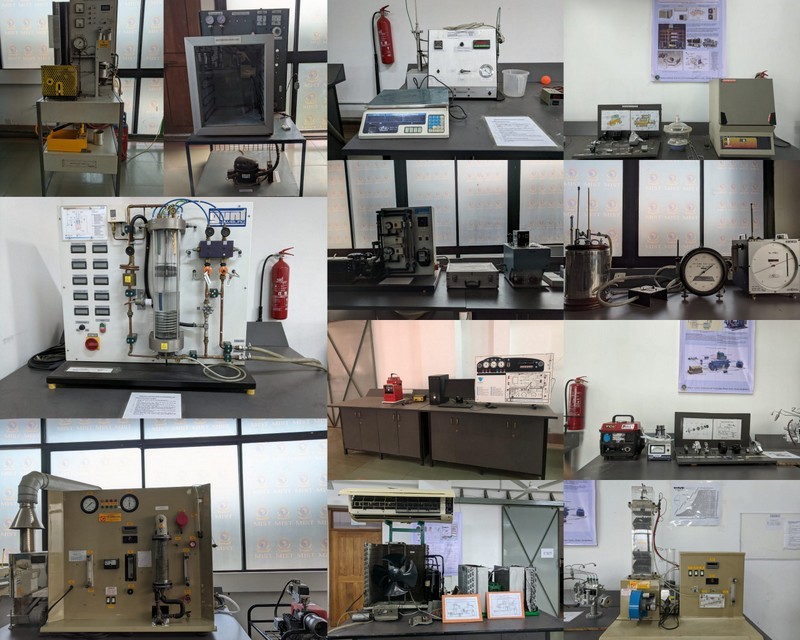
The Thermodynamics Laboratory is dedicated to studying the principles and applications of energy transformation, particularly those involving heat and work. The lab plays a crucial role in understanding real-world processes such as combustion in power plants and engines, as well as refrigeration cycles used in cooling and air-conditioning systems. Students and researchers use the facility to observe how energy is transferred, converted, and utilized in various mechanical and thermal systems.
To support these investigations, the Thermodynamics Lab is equipped with a wide range of instruments and experimental setups that allow precise measurement and analysis of important thermal parameters. These include temperature, pressure, heat transfer, fuel characteristics, and the performance of thermal machines. Each piece of equipment helps users gain hands-on experience and deeper insight into thermodynamic principles.
Major Equipment in the Thermodynamics Laboratory
-
Flash Point & Fire Point Tester
Used to determine the flash point and fire point of fuels and oils, helping evaluate their safety and combustion characteristics. -
Viscosity Tester
Measures the viscosity of fluids, which affects lubrication, fuel flow, and thermal efficiency in engines and machinery. -
Boiler (Trainer Model)
A small-scale educational boiler used to demonstrate steam generation, boiler components, and operating principles. -
Boiler (Industrial Model)
A larger, industrial-style boiler that provides realistic exposure to steam production and thermal system management in power plants. -
Steam Turbine
Allows students to study how thermal energy from steam is converted into mechanical work, forming the basis of steam power plants. -
Carbon Residue Tester
Determines the amount of carbon left after fuel evaporation, indicating fuel quality and combustion efficiency. -
Cooling Tower
Demonstrates principles of heat rejection, evaporation, and cooling of water used in industrial processes and power plants. -
Gas Turbine
Used to study the operation of gas turbine engines, including air compression, combustion, expansion, and power generation. -
Internal Combustion (IC) Engine
Provides hands-on experience with engine operation, performance testing, fuel combustion, and efficiency analysis. -
Boys’ Gas Calorimeter
Measures the calorific value of a gas fuel, which is essential for analyzing energy content and combustion performance.